I stole my sister's arduino kit.
More On Electricity
Some more stuff I thought would be important to my understanding of electricity.
Resistors In a Series demonstrate the interesting interaction between voltage and resistance. Lets say there is a simple circuit consisting of a battery, a resistor (R1), another resistor (R2), which then connect to ground. For this explanation, let's say there is a reference M that represents the a point between R1 and R2. If R1 = R2, L = 2.5 V because the resistors drop the voltage equally. If R1 >> R2, L = 0 V because R1's resistance is so large compared to R2, it drops the voltage basically to 0. This means R2 >> R1 would mean L = 5 V.
Conceptually, what is going on?
Resistors in a series share the total voltage proportional to their resistance values and current is the same through both resistors.
High vs. Low Impedence is a new concept this week but is quite intuitive and logical. This explanation will utilize the same simple circuit as above, but this time a multimeter will be connect to point L and ground, so it goes battery, R1, and R2 and Rm(resistance of the multimeter) are parallel which connect to ground. For the situation R1 = R2 = Rm, R-parrallel is lower relative to R1. This matched impedence example shows that the multimeter will still mess up the circuit and the multimeter reading. Rm << R1 = R2, the low impedence of the multimeter cause the reading to be messed up because the multimeter creates a circuit to ground and causes the almost all the voltage to drop in the upstream. if Rm was >> this is an example of a high impedence meter, so the meter is affecting the circuit in a neglible way.
3D Scanning
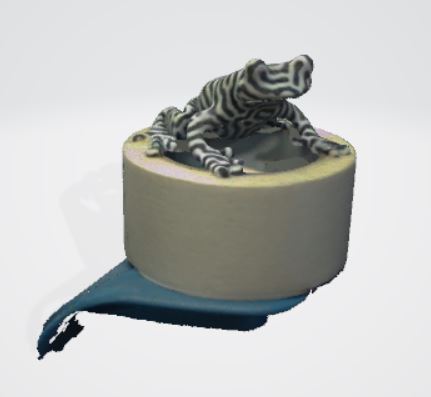
The process wasn't too hard actually.
3D Printing
This was what I wanted to recreate.

Here's what I made: